Publications
publications in reversed chronological order.
2026
- Shear Inference
 SHINE: Shear inference environment - Generative forward modelling for radio weak gravitational lensingEzequiel Centofanti, Benjamin Remy, Emma Ayçoberry, and 3 more authors2026
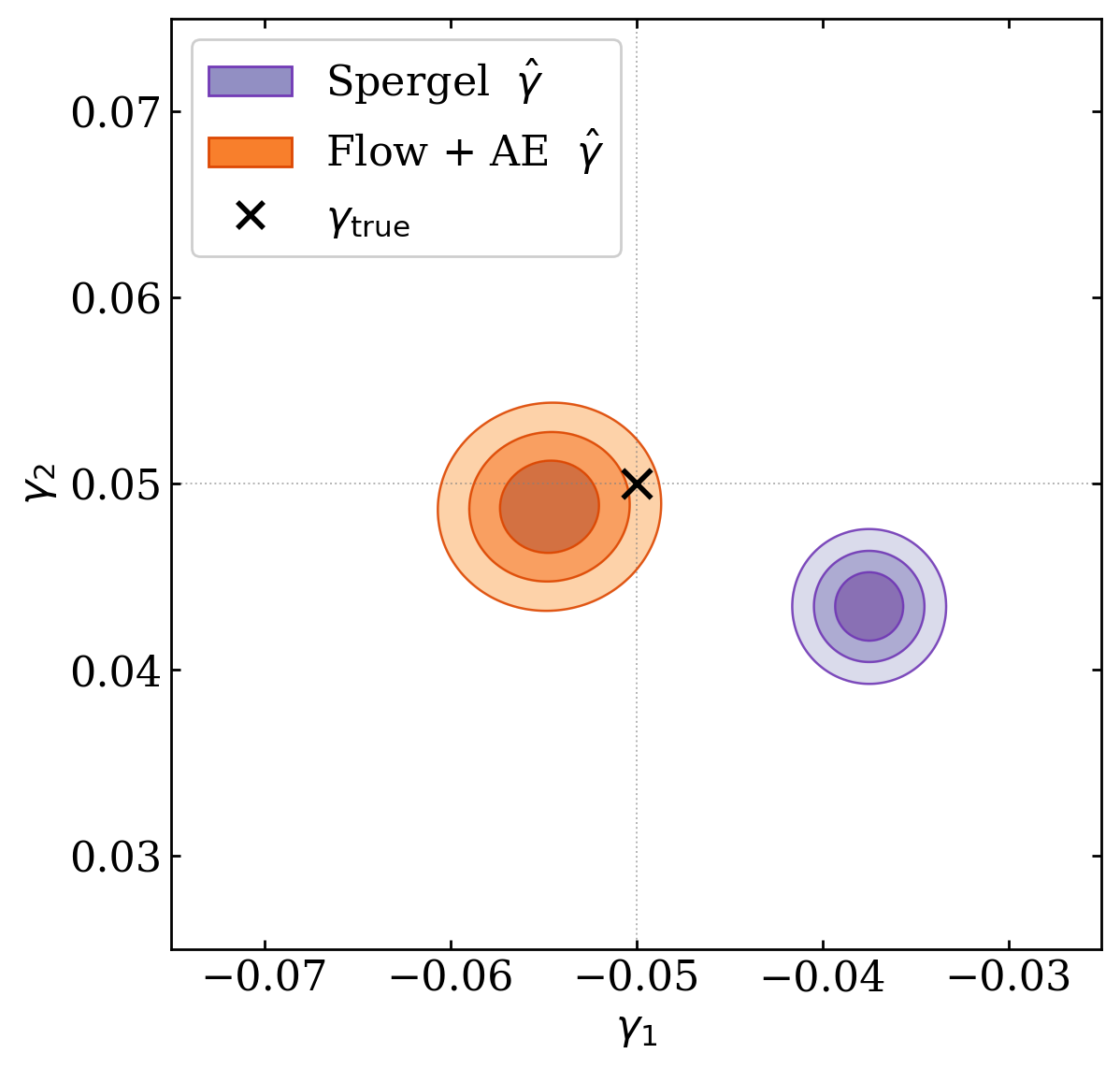
Next-generation radio interferometers, such as SKA, will observe the radio sky with unprecedented sensitivity and resolution. Their wide sky coverage will enable weak gravitational lensing studies using radio data, which not only complement optical observations but also probe higher redshifts. However, traditional shear estimation methods—based on measuring the ellipticity of observed galaxies—are not directly applicable to radio interferometric data. Interferometric observations are acquired in the Fourier domain, where galaxy images are delocalised, making shape measurements non-trivial. Furthermore, deconvolution methods such as CLEAN and its variants can introduce systematic errors when converting observations to the image domain, biasing shear estimates. To address these challenges, we propose a cosmic shear inference method based on forward generative modelling, which avoids explicit shape measurements. Our forward model simulates galaxy images, applies the shear transformation, and includes the instrumental response of the radio interferometer, with the likelihood explicitly defined in Fourier space. Using Monte Carlo sampling algorithms, we estimate the posterior distribution of the cosmic shear conditioned on a set of galaxy observations that share a common shear. We obtain unbiased shear estimates with sub-percent accuracy when applied to parametric galaxy simulations. We compare our method to state-of-the-art shear estimators, demonstrating a reduction in uncertainty of up to 3 times and no apparent multiplicative bias. Furthermore, we carry out coverage tests to show that our posterior estimates are well calibrated. We then show that applying this parametric model to COSMOS galaxies with realistic morphologies introduces a bias in the shear estimate over 10σ. Finally, we demonstrate that, by incorporating a generative forward model based on a variational autoencoder trained on real galaxy images, we can mitigate this bias to below the 2σlevel.
@misc{centofanti2026radiowl, title = {SHINE: Shear inference environment - Generative forward modelling for radio weak gravitational lensing}, author = {Centofanti, Ezequiel and Remy, Benjamin and Ayçoberry, Emma and Lanusse, François and Starck, Jean-Luc and Farrens, Samuel}, year = {2026}, url = {Submitted to A\&A for review}, } - Phase Retrieval
 Point spread function wavefront recovery from in-focus stellar observationsEzequiel Centofanti, Samuel Farrens, Jean-Luc Starck, and 1 more author2026
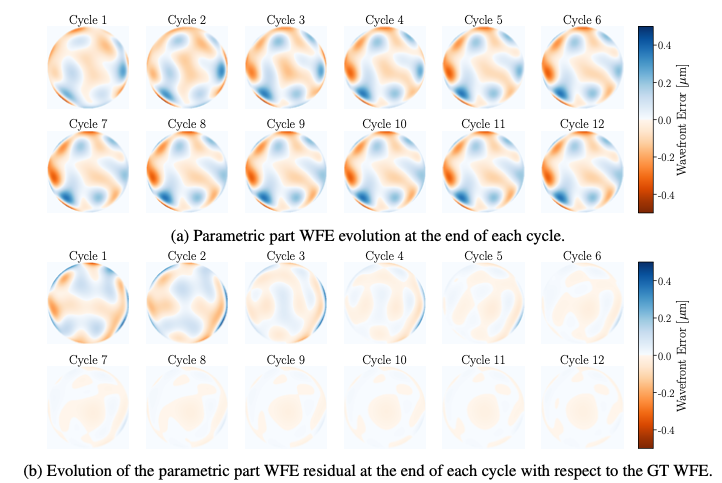
Recovering the wavefront error (WFE) field of an optical system from intensity in-focus observations is a challenging inverse problem with broad implications for telescope point spread function (PSF) modelling. Accurate WFE recovery enables both precise PSF modelling and direct insight into the state of the telescope optics, facilitating the detection of potential malfunctions. Recently, non-parametric PSF models have shown promising performance in modelling complex optical systems in space-based telescopes. WaveDiff is a semi-parametric PSF model that represents the PSF in wavefront space by combining parametric and learnable features with a differentiable forward optical model. This parameterisation enables phase retrieval from in-focus observations by exploiting the spatial variation of the PSF across the field of view (FOV). The original version of WaveDiff achieves outstanding PSF recovery results in pixel space; however, the recovered WFE is far from the ground truth, with a relative error of around 30%. In this paper, we present a new optimisation scenario that bridges WaveDiff’s parametric and non-parametric components through wavefront feature projection, yielding a substantial improvement in WFE recovery and making WaveDiff the first demonstrated method to combine wide-field WFE recovery, in-focus-only polychromatic observations, and non-parametric wavefront features in a single framework. We show that incorporating wavefront projections and increasing the number of optimisation cycles enables WaveDiff to recover the WFE with an error of approximately 3% using only noisy, undersampled, in-focus observations. This represents a tenfold improvement over the original model while further reducing the pixel-space error. The code to reproduce the results of this article is publicly available at https://github.com/tobias-liaudat/wf-psf/tree/v1.4.0.
@misc{centofanti2026phaseretrieval,
  title = {Point spread function wavefront recovery from in-focus stellar observations},
  author = {Centofanti, Ezequiel and Farrens, Samuel and Starck, Jean-Luc and Liaudat, Tobias I.},
  year = {2026},
  archiveprefix = {arXiv},
  doi = {10.48550/arXiv.2607.01032},
  url = {https://doi.org/10.48550/arXiv.2607.01032},
  journal = {A&A}
}
2025
- argosim
 argosim: a Python package for radio interferometric simulationsEzequiel Centofanti, Emma Ayçoberry, Samuel Farrens, and 4 more authors2025
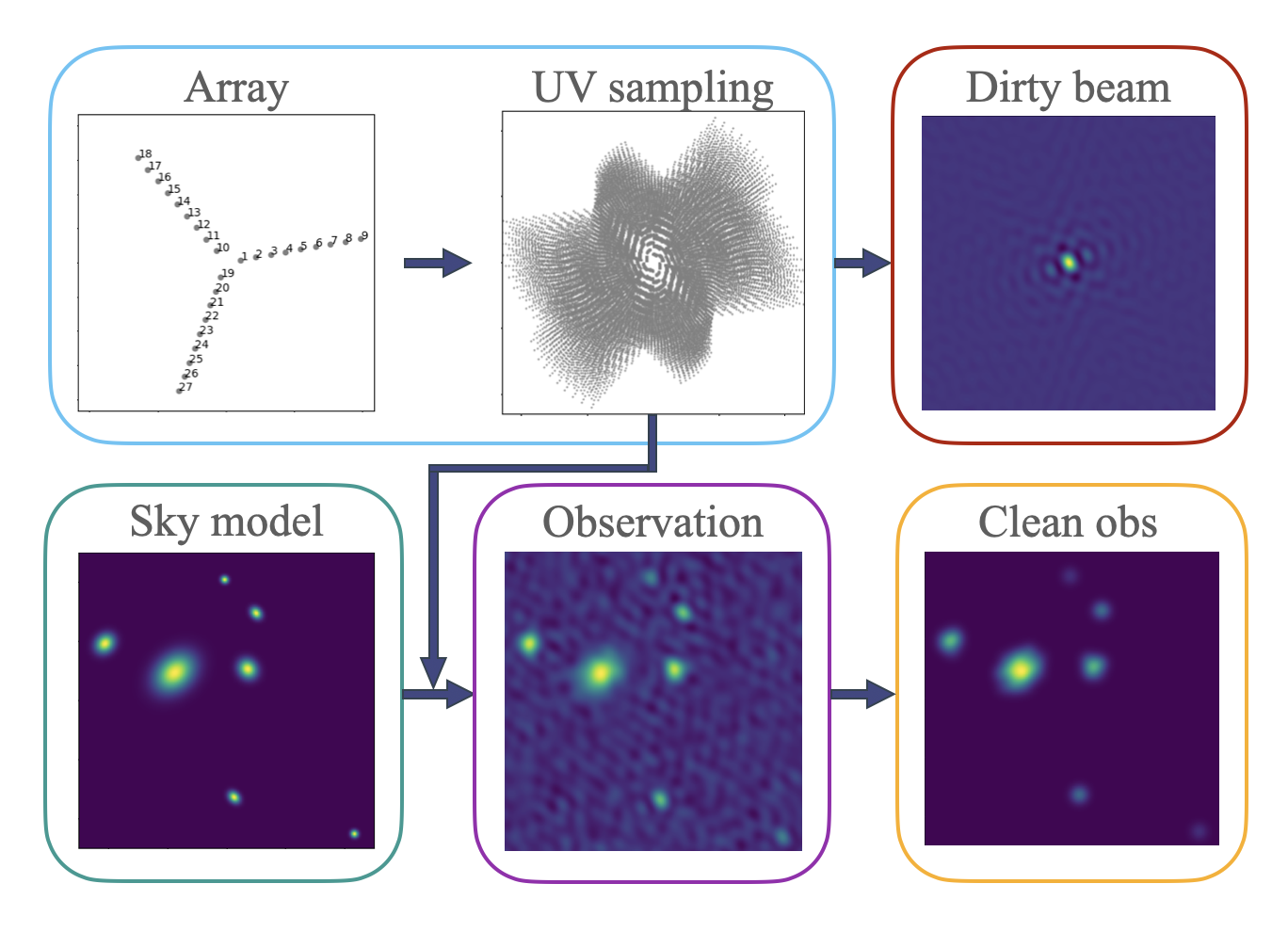
In this paper, we present argosim a Python package for simulating radio interferometric observations. The argosim package is modular, lightweight and compatible with all major operating systems. Its computational backend is written in JAX which allows for greatly accelerated performance as well as the advantage of being fully differentiable. We detail the main argosim modules and describe how to use them to generate an observation, from the antenna positions to the cleaned image. The package is a fully open-source project, and its code is publicly available on GitHub.
@misc{centofanti2025_argosim, title = {argosim: a Python package for radio interferometric simulations}, author = {Centofanti, Ezequiel and Ayçoberry, Emma and Farrens, Samuel and Gullin, Samuel and Bensahli, Manal and Starck, Jean-Luc and Antoniadis, John}, year = {2025}, eprint = {2606.25573}, archiveprefix = {arXiv}, doi = {10.48550/arXiv.2606.25573}, primaryclass = {astro-ph.IM}, url = {https://doi.org/10.48550/arXiv.2606.25573}, journal = {A&A} } - Stellar Classification
 Breaking the degeneracy in stellar spectral classification from single wide-band imagesEzequiel Centofanti, Samuel Farrens, Jean-Luc Starck, and 3 more authorsA&A, Jan 2025
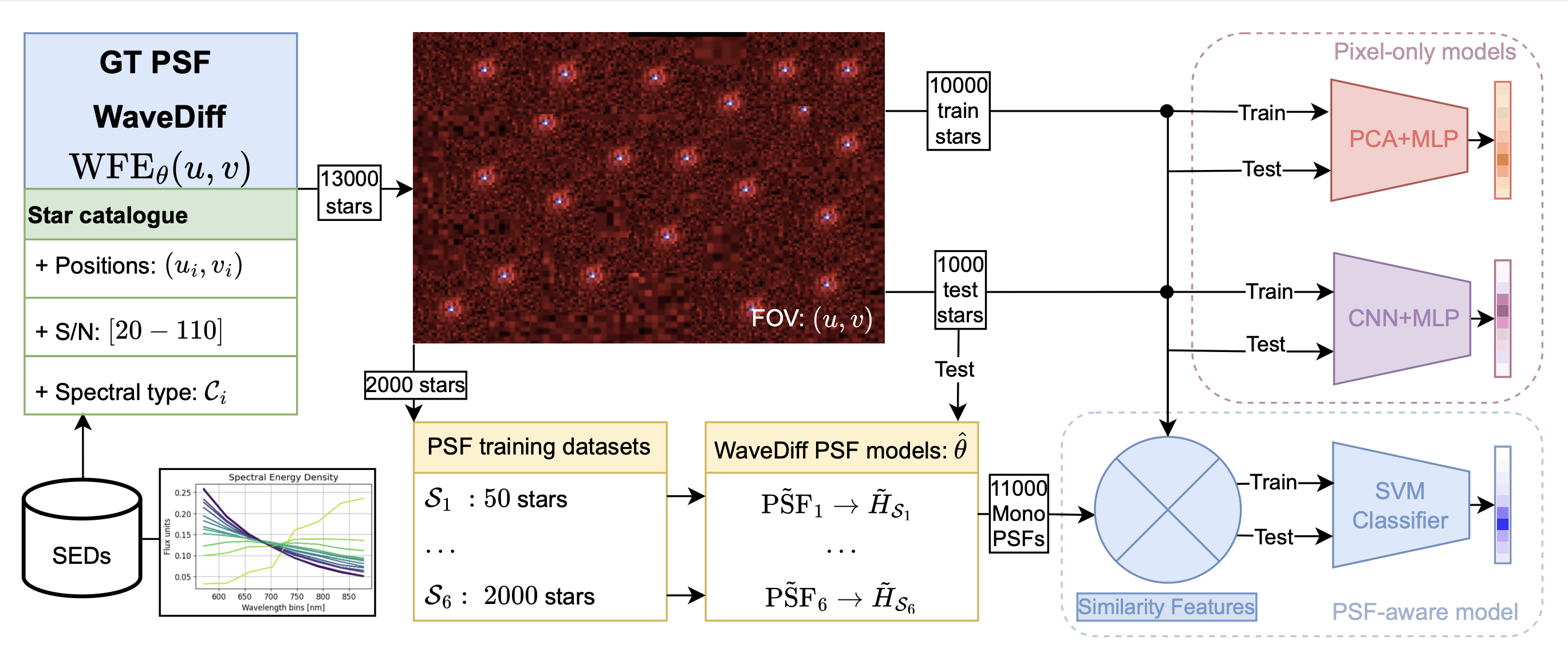
The spectral energy distribution (SED) of observed stars in wide-field images is crucial for chromatic point spread function (PSF) modelling methods, which use unresolved stars as integrated spectral samples of the PSF across the field of view. This is particu- larly important for weak gravitational lensing studies, where precise PSF modelling is essential to get accurate shear measurements. Previous research has demonstrated that the SED of stars can be inferred from low-resolution observations using machine-learning classification algorithms. However, a degeneracy exists between the PSF size, which can vary significantly across the field of view, and the spectral type of stars, leading to strong limitations of such methods. We propose a new SED classification method that incorpo- rates stellar spectral information by using a preliminary PSF model, thereby breaking this degeneracy and enhancing the classification accuracy. Our method involves calculating a set of similarity features between an observed star and a preliminary PSF model at different wavelengths and applying a support vector machine to these similarity features to classify the observed star into a specific stellar class. The proposed approach achieves a 91% top-two accuracy, surpassing machine-learning methods that do not consider the spectral variation of the PSF. Additionally, we examined the impact of PSF modelling errors on the spectral classification accuracy.
@article{centofanti2025,
  author = {{Centofanti}, Ezequiel and {Farrens}, Samuel and {Starck}, Jean-Luc and {Liaudat}, Tobías I. and {Szapiro}, Alex and {Pollack}, Jennifer},
  title = {{Breaking the degeneracy in stellar spectral classification from single wide-band images}},
  keywords = {Astrophysics - Instrumentation and Methods for Astrophysics},
  year = {2025},
  month = jan,
  archiveprefix = {arXiv},
  doi = {10.1051/0004-6361/202452224},
  url = {https://doi.org/10.1051/0004-6361/202452224},
  journal = {A&A},
  volume = {694},
  pages = {A228}
}
2023
- Deep Unrolling
 Stability of Unfolded Forward-Backward to Perturbations in Observed DataCécile Valle, Ezequiel Centofanti, Emilie Chouzenoux, and 1 more authorIn 2023 31st European Signal Processing Conference (EUSIPCO), Sep 2023
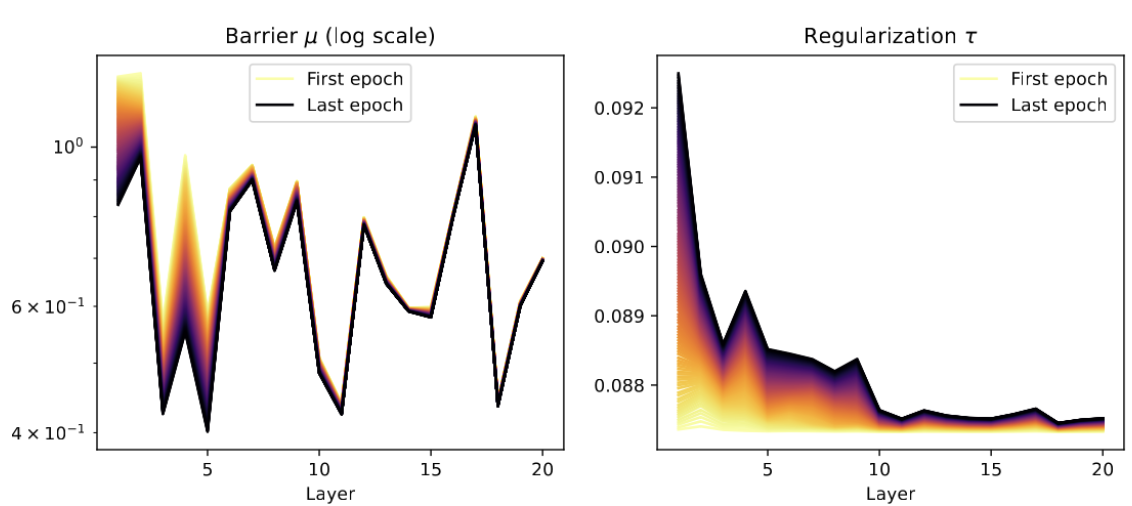
We consider a neural network architecture to solve inverse problems, which is built by unfolding a forward-backward algorithm. This algorithm is based on the minimization of an objective function which corresponds to a penalized least squares problem. In this context, ensuring stability is consistent with inverse problem theory since it guarantees both the continuity of the inversion method and its insensitivity to small noise. The latter is a critical property as deep neural networks have been shown to be vulnerable to adversarial perturbations. The main novelty of our work is to analyze the robustness of this inversion method with respect to a perturbation of the bias parameter of the network. In our architecture, the bias accounts for the observed data in the inverse problem. The analysis is performed by using tools of fixed point theory. Our theoretical results are illustrated by numerical simulations on a problem of signal restoration.
@inproceedings{deValle2023,
  author = {de Valle, Cécile and Centofanti, Ezequiel and Chouzenoux, Emilie and Pesquet, Jean-Christophe},
  booktitle = {2023 31st European Signal Processing Conference (EUSIPCO)},
  title = {Stability of Unfolded Forward-Backward to Perturbations in Observed Data},
  year = {2023},
  month = sep,
  volume = {},
  number = {},
  pages = {865-869},
  issn = {2076-1465},
  keywords = {Training;Inverse problems;Signal restoration;Perturbation methods;Signal processing algorithms;Reliability theory;Numerical simulation;neural networks;unfolding;stability;forward-backward algorithm;inverse problems},
  doi = {10.23919/EUSIPCO58844.2023.10290061}
}